
Germany continues to be one of the most sought-after destinations for higher education, skilled employment, research, nursing, vocational training, and long-term career growth. As a result, demand for internationally recognized German language certifications has grown significantly.
Among these qualifications, the Goethe B1 and TELC B1 certificates are widely accepted by employers, educational institutions, and organizations across Germany and other German-speaking countries.
One of the most common questions prospective learners ask is:
“Do I need to take the Goethe A1 and Goethe A2 exams before I can sit for the Goethe or TELC B1 examination?”
The answer is No.
You are not required to obtain Goethe or TELC certificates at the A1 or A2 levels before registering for the B1 examination. What matters is that your language proficiency meets the CEFR B1 standard.
This means you can:
- Complete a structured German A1 course
- Progress to a German A2 course
- Finish a German B1 course
- Directly register for the Goethe B1 or TELC B1 examination
This approach enables learners to build a strong linguistic foundation while avoiding the cost and time associated with multiple certification exams.
In this guide, you’ll discover:
- Whether you can legally skip the A1 and A2 examinations
- A structured four-month A1–B1 learning roadmap
- The Goethe and TELC B1 exam format
- Study strategies used by successful candidates
- Common mistakes to avoid
- Expert recommendations to maximize your chances of passing on your first attempt
Can You Skip the Goethe A1 and A2 Exams?
Yes.
This is one of the most misunderstood aspects of German language certification.
The Goethe-Institut and TELC do not require candidates to complete lower-level examinations before attempting a higher-level examination. Their exams are proficiency-based rather than sequential.
If your German language ability corresponds to CEFR Level B1, you may register directly for the B1 examination regardless of whether you have previously taken A1 or A2 certification exams. Blog
For this reason, many learners choose to complete structured training at the A1, A2, and B1 levels and then take only the B1 certification exam.
This pathway is especially suitable for:
- Students planning to study in Germany
- Skilled professionals seeking employment
- Nurses and healthcare workers
- Engineers and IT specialists
- Researchers
- Individuals preparing for visa or family reunification requirements
Why the B1 Certificate Matters?
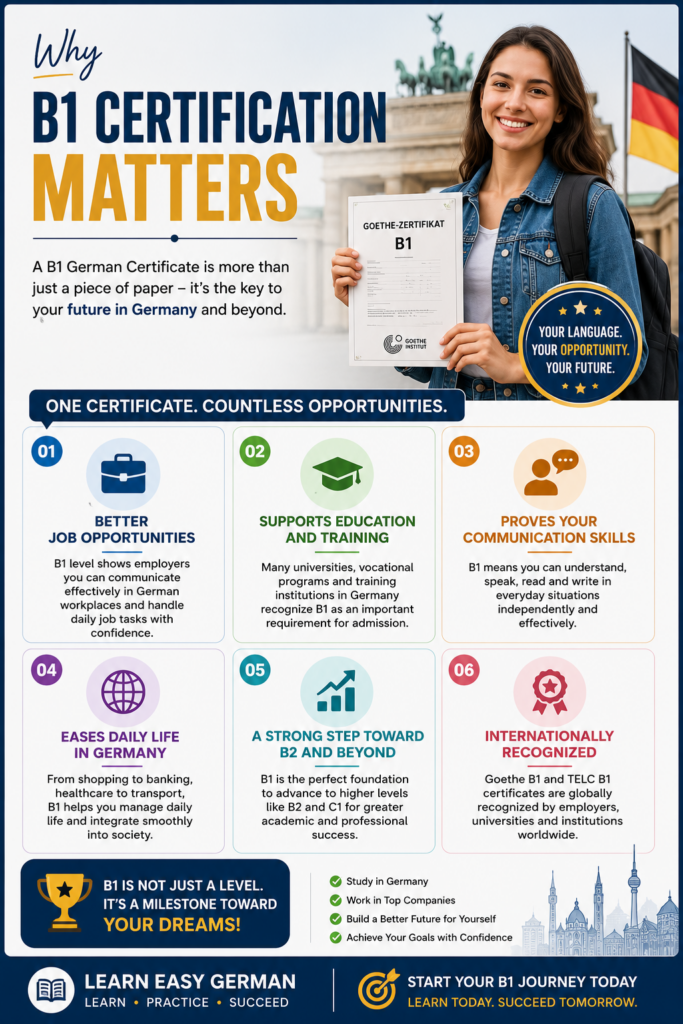
The B1 level represents a significant milestone in language learning because it marks the transition from basic communication to independent language use.
At the B1 level, you should be able to:
- Understand the main points of conversations on familiar topics
- Communicate confidently in everyday and workplace situations
- Write clear emails, letters, and short reports
- Express opinions, explain experiences, and discuss future plans
- Read newspaper articles and informational texts
- Participate in discussions using connected sentences
These are precisely the competencies assessed in both the Goethe and TELC B1 examinations.
Our Intensive Four-Month Learning Path
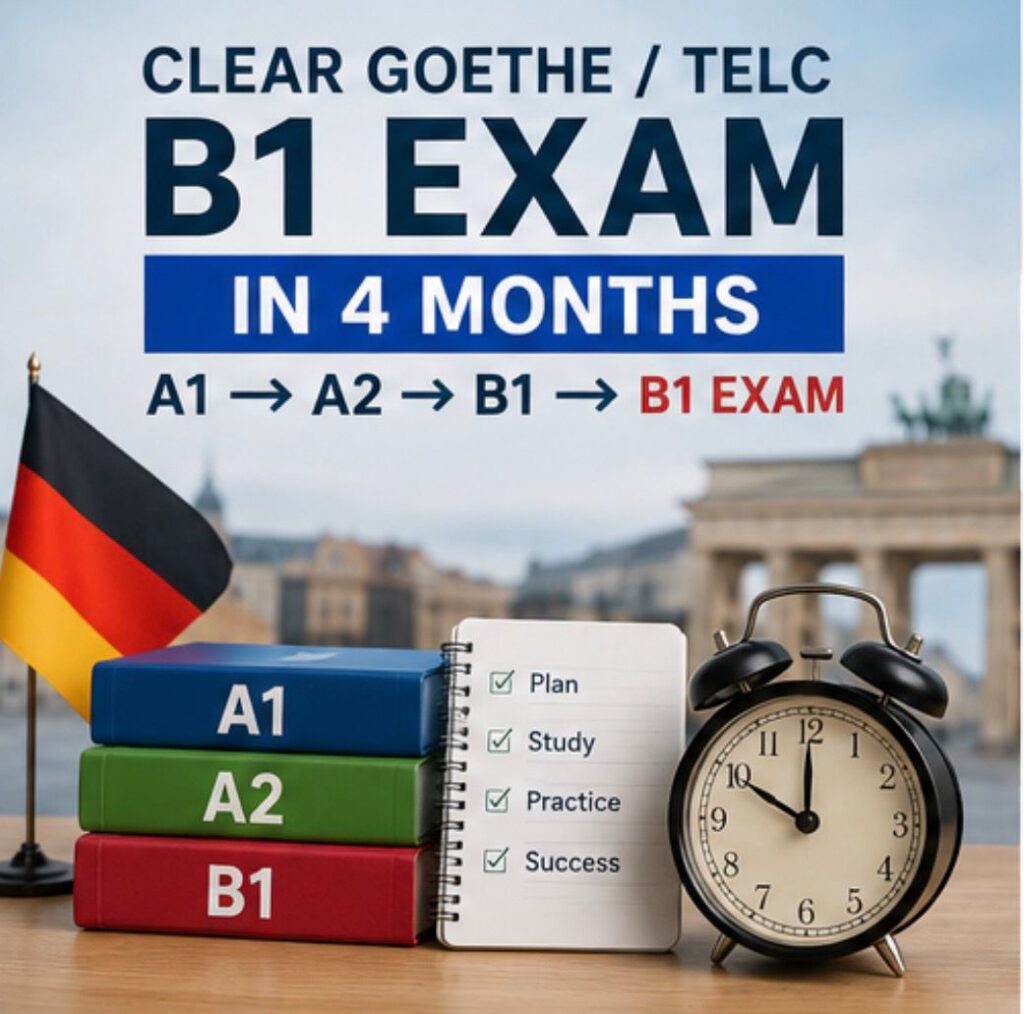
A successful B1 result is built on a strong progression through the earlier language levels. Our Fast-Track Program is designed to develop these competencies step by step.
Month 1 – German A1 Foundation
The first month focuses on building essential communication skills.
You will learn:
- Pronunciation and phonetics
- Greetings and introductions
- Numbers, dates, and time
- Family and daily routines
- Shopping and food
- Basic grammar
- Present tense
- Sentence structure
- Core vocabulary
By the end of A1, you will be able to manage simple everyday interactions confidently.
Month 2 – German A2 Development
During the second month, learners expand both vocabulary and grammatical accuracy.
Topics include:
- Employment
- Travel
- Housing
- Healthcare
- Education
- Banking
- Public services
- Technology
- Leisure activities
Grammar is developed through practical communication, including:
- Past tense
- Modal verbs
- Separable verbs
- Reflexive verbs
- Comparative structures
- Subordinate clauses
At this stage, learners begin expressing ideas in greater detail and handling more complex situations.
Month 3 – German B1 Mastery
The B1 phase emphasizes independent communication and exam-oriented language use.
Students practice:
- Giving presentations
- Expressing opinions
- Participating in discussions
- Writing formal and informal correspondence
- Solving everyday problems through communication
- Workplace interactions
Advanced grammar includes:
- Relative clauses
- Passive voice
- Konjunktiv II
- Future tense
- Adjective declension
- Complex sentence construction
Month 4 – Intensive Goethe/TELC B1 Preparation
The final month is dedicated exclusively to examination readiness.
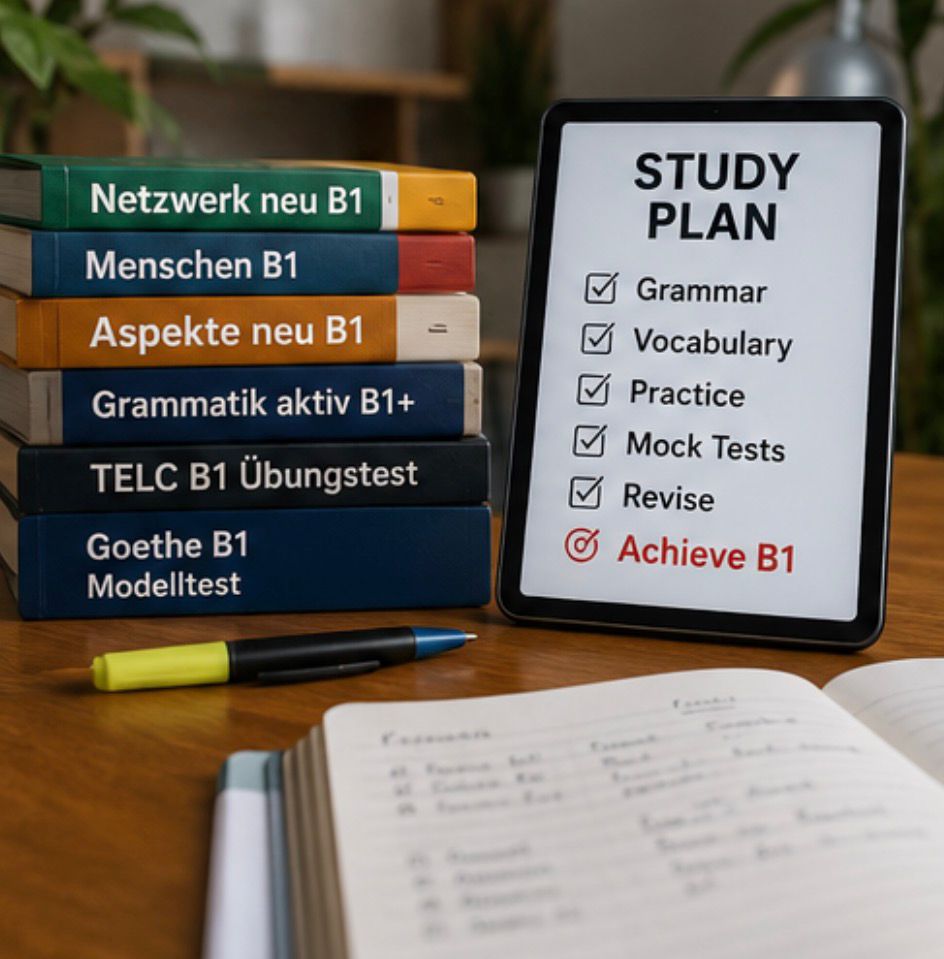
Learners complete:
- Full-length mock examinations
- Timed reading practice
- Listening comprehension exercises
- Structured writing tasks with detailed feedback
- Guided speaking simulations
- Grammar revision sessions
- Vocabulary consolidation
This stage helps students become familiar with the examination format while improving confidence and time management.
What Makes Our Program Different?
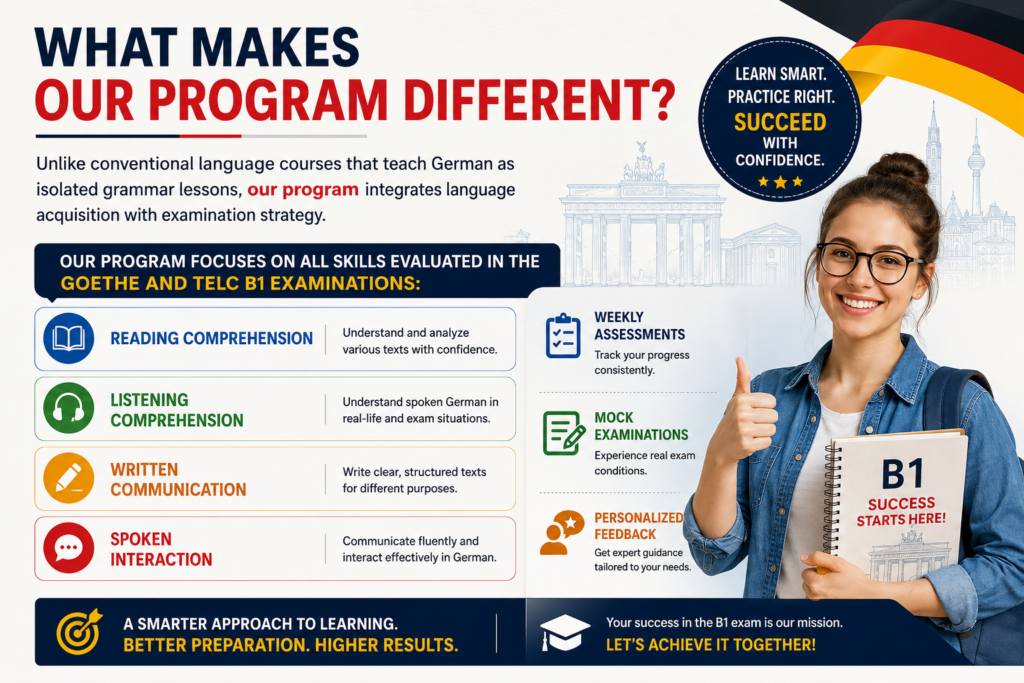
Unlike conventional language courses that teach German as isolated grammar lessons, our program integrates language acquisition with examination strategy.
Every module is designed to improve one or more of the four competencies evaluated in the Goethe and TELC B1 examinations:
- Reading comprehension
- Listening comprehension
- Written communication
- Spoken interaction
Weekly assessments, mock examinations, and personalized feedback ensure that learners receive continuous guidance throughout the program.
Frequently Asked Questions
Can I take the Goethe B1 exam without Goethe A1 and A2 certificates?
Yes. Neither Goethe nor TELC requires candidates to possess A1 or A2 certificates before registering for the B1 examination.
Is four months enough to prepare?
For highly motivated learners who study consistently and follow an intensive, structured curriculum covering A1, A2, and B1, four months can be sufficient to prepare for the B1 examination. Individual progress will depend on prior language experience, study habits, and the amount of practice dedicated to all four language skills.
Which certificate should I choose?
Both Goethe B1 and TELC B1 are internationally recognized. The appropriate choice depends on your intended purpose, such as university admission, employment, or specific institutional requirements.
At Learn Easy German, our goal is not simply to help students complete a course—we prepare them to communicate confidently and perform successfully in internationally recognized examinations.
Our Fast-Track Program includes:
- Comprehensive German A1, A2, and B1 curriculum Home
- Live instructor-led online classes
- Experienced German language trainers
- Small batch sizes
- Weekly assessments
- Intensive speaking practice
- Personalized writing evaluations
- Full-length Goethe and TELC mock examinations
- Flexible weekday and weekend schedules
Whether your objective is to study, work, or build a future in Germany, our structured learning pathway provides the knowledge, confidence, and examination skills required to achieve your goals.
Every fluent German speaker was once a beginner. The difference between those who succeed and those who give up is not intelligence—it’s consistency, the right guidance, and a clear roadmap.
By progressing systematically through A1, A2, and B1, you’ll develop the confidence, vocabulary, grammar, and communication skills needed to succeed in the Goethe or TELC B1 examination and beyond. Contact
Don’t learn German just to pass an exam.
Learn German to build a future.
Whether your destination is a German university, a multinational company, a healthcare career, or a new life in Germany, your language journey starts today.
Invest in your future. Learn with confidence. Pass with excellence.
Learn Easy German — Where Your German Journey Becomes a Success Story.
