
Six months from today, you’re holding your German language certificate in your hands.
You’ve successfully cleared your Goethe exam, impressed interviewers with your communication skills, and are one step closer to studying, working, or settling in Germany.
Sounds ambitious?
It is—but for many learners, it can be achievable with the right strategy, consistency, and expert guidance.
Whether you’re preparing for your first A1 exam or aiming for the more challenging B2 level, this guide will help you build an effective learning routine and avoid common mistakes that slow down progress.
Let’s explore how to prepare smarter—not just harder.
Is It Really Possible to Reach B2 in 6 Months?
The answer depends on three important factors:
- Your current level of German
- The amount of time you can dedicate each day
- The quality of your learning method
If you are starting from absolute zero, reaching B2 in six months requires an intensive schedule—typically several hours of focused study every day—and many learners may need longer. If you already have some foundation (for example, A1 or A2), progressing to B2 within six months is much more realistic.
The goal isn’t to rush—it’s to learn efficiently and build lasting language skills.
Why Most Students Fail German Exams
Many learners spend months studying but still struggle during the exam.
The most common reasons include:
- Memorizing vocabulary without using it in conversation
- Ignoring pronunciation and speaking practice
- Studying grammar without applying it in writing and speaking
- Practicing only before the exam instead of consistently
- Taking too few mock tests
- Not understanding the exam format
Passing a German exam requires balanced preparation across all four language skills.
Understand the Exam Structure First

Every Goethe / TELC exam evaluates four core skills:
Reading (Lesen)
Tests your ability to understand written German, from notices and emails to articles and longer texts.
Listening (Hören)
Measures how well you understand conversations, announcements, interviews, and everyday spoken German.
Writing (Schreiben)
Requires you to write emails, letters, messages, or opinion-based texts depending on the level.
Speaking (Sprechen)
Evaluates pronunciation, fluency, grammar, vocabulary, and your ability to communicate naturally.
Many students focus only on grammar and vocabulary while neglecting speaking—the skill that often builds confidence across all sections.
A Realistic 6-Month Study Plan
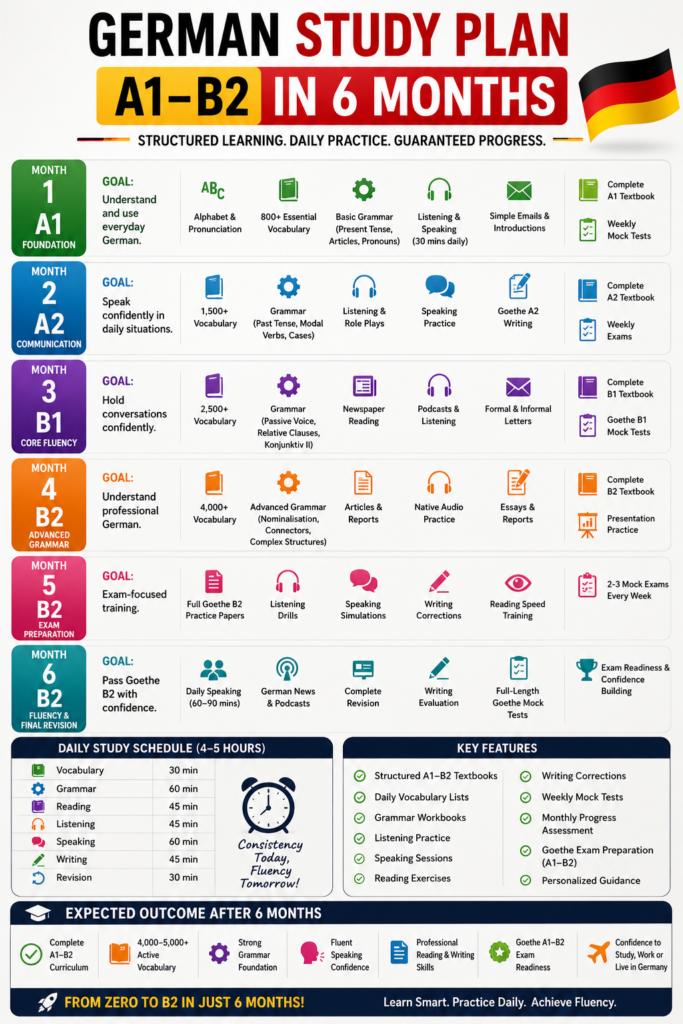
Month 1: Build Your Foundation
Focus on:
- German alphabet and pronunciation
- Basic sentence structure
- Essential vocabulary
- Present tense
- Articles and genders
- Daily speaking practice
Study time:
2–3 hours per day.
Month 2: Strengthen Core Skills
Learn:
- Modal verbs
- Past tense basics
- Daily conversations
- Common exam vocabulary
- Listening exercises
- Short writing tasks
Complete your first full mock test by the end of the month.
Month 3: Increase Speaking Confidence
This month should focus heavily on communication.
Practice:
- Introducing yourself
- Expressing opinions
- Asking and answering questions
- Picture descriptions
- Role plays
- Email writing
Speaking every day—even for 20–30 minutes—can make a significant difference
Month 4: Intensive Grammar and Exam Practice
Master:
- Relative clauses
- Passive voice (where applicable)
- Konjunktiv II basics
- Complex sentence connectors
- Advanced listening
- Timed reading exercises
Start taking one full mock exam every week.
Month 5: Exam Simulation
Treat every practice test like the real exam.
Time yourself.
Review every mistake.
Strengthen weak areas.
Increase vocabulary related to work, education, travel, and everyday situations.
Month 6: Final Revision
Don’t try to learn entirely new topics.
Instead:
- Revise vocabulary
- Review grammar
- Practice speaking daily
- Complete multiple mock exams
- Improve time management
- Sleep well before the exam
Consistency matters more than cramming.
Daily Study Schedule:
A balanced routine could include:
- Vocabulary: 20–30 minutes
- Grammar: 30–45 minutes
- Reading: 20 minutes
- Listening: 20 minutes
- Writing: 20 minutes
- Speaking: 30–45 minutes
Regular practice is more effective than studying everything on one day.
Tips to Improve Each Skill

Reading
Read short German articles, notices, and simple stories every day.
Listening
Listen to German podcasts, news, and dialogues suitable for your level.
Writing
Write short emails, diary entries, and opinion paragraphs. Get feedback whenever possible.
Speaking
Speak from day one. Even simple conversations build fluency and confidence over time.
Common Mistakes to Avoid:
- Translating every sentence from your native language
- Learning long vocabulary lists without context
- Ignoring pronunciation
- Avoiding speaking because you’re afraid of mistakes
- Skipping revision
- Practicing only before the exam
Language learning improves through regular use, not perfection.
Best Resources for German Exam Preparation:
Choose learning materials that align with your exam level and provide structured practice.
Look for:
- CEFR-aligned textbooks
- Official practice papers
- Vocabulary lists
- Listening exercises
- Speaking practice with feedback
- Mock exams
Combining self-study with guided instruction often helps learners stay consistent and identify areas for improvement.
Why does structured learning make a Difference?

A structured course can help you:
- Follow a clear roadmap
- Stay motivated
- Practice speaking regularly
- Receive corrections on writing
- Understand exam expectations
- Build confidence before test day
Many learners find that regular interaction with experienced trainers and peers accelerates their progress compared with studying alone.
Frequently Asked Questions?
Can I learn German from A1 to B2 in six months?
It depends on your starting level, study time, and consistency. Learners who already have some German knowledge and can dedicate several hours each day may progress quickly, while complete beginners often need more time to reach B2 comfortably.
Which German exam is best?
The best choice depends on your goals. Goethe exams are widely recognized internationally, while other recognized exams may also be accepted by employers and educational institutions.
How many hours should I study every day?
For intensive preparation, aim for two to four hours of focused study, along with regular speaking practice.
Is speaking the hardest section?
Many learners find speaking challenging because they practise it less often. Daily conversation practice can significantly improve confidence.
Is grammar enough to pass?
No. Success requires balanced preparation in reading, listening, writing, and speaking.
Your dream of studying, working, or building a successful career in Germany doesn’t begin when you land in Germany—it begins with the decision to start learning today.
Every new word you master, every conversation you practise, and every exam you pass brings you one step closer to that dream.
